Weight Loss After 40: Hormones, Stress & Metabolism
Why It’s Harder to Lose Weight After 40
If you’ve ever found yourself thinking, “I’m doing the same things I used to, but nothing is working anymore,” you’re not imagining it.
Weight loss after 40 often feels very different than it did in your 20s or 30s. Strategies that once seemed effective — eating less, adding more cardio, or simply becoming more active — may no longer lead to the same results.
This is one of the most common frustrations we hear from women navigating this stage of life. And in many cases, it’s not about a lack of effort or discipline. The body itself is changing.
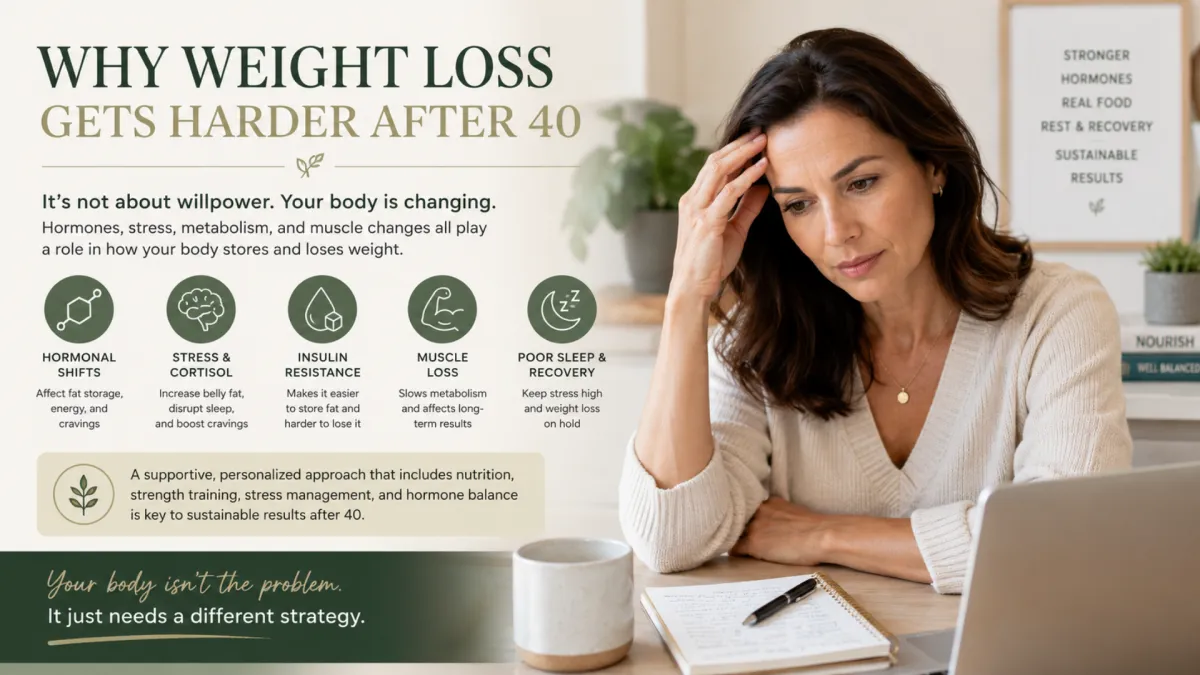
Hormones, stress response, metabolism, muscle mass, sleep quality, and blood sugar regulation all begin to influence weight in more noticeable ways over time. Understanding those shifts can help explain why old strategies stop working — and why a more supportive, personalized approach often works better.
Your Body Is Not Working Against You
One of the most important things to understand is that your body is not “broken.” It’s adapting.
As we age, the body becomes more sensitive to stress, recovery, inflammation, and metabolic demands. It works harder to conserve energy and maintain stability during hormonal changes.
For many women, this transition becomes especially noticeable during perimenopause and menopause, when estrogen and progesterone levels begin to fluctuate more significantly. These hormonal shifts can affect appetite, muscle maintenance, insulin sensitivity, sleep, and where fat is stored.
The good news is that when we begin working with these physiological changes instead of fighting against them, weight loss often becomes more sustainable and less exhausting.
Why Traditional Weight Loss Approaches Often Stop Working
Many women were taught that weight loss simply comes down to eating less and exercising more.
While calorie balance does matter, overly restrictive dieting and excessive cardio can become counterproductive over time, especially after 40.
Chronic under-eating may increase stress hormones, slow metabolic rate, and contribute to muscle loss. Excessive cardio without adequate recovery can also place additional stress on the body.
Instead of seeing progress, many women notice:
Increased fatigue
Stronger cravings
Weight loss plateaus
Loss of muscle tone
More stubborn abdominal weight
At this stage, the body often responds better to nourishment, strength support, blood sugar balance, and recovery than it does to extremes.
Hormones, Stress, and Metabolism
Weight regulation is closely connected to hormonal and metabolic health.
Hormonal Shifts
Changes in estrogen, progesterone, testosterone, and insulin can influence:
Fat storage patterns
Muscle maintenance
Hunger and cravings
Energy production
Recovery and sleep quality
For women, declining estrogen during perimenopause may contribute to increased abdominal fat storage and changes in insulin sensitivity.
Cortisol and Chronic Stress
Stress becomes more metabolically impactful with age.
When cortisol remains elevated for long periods of time, it can:
Increase fat storage around the midsection
Disrupt sleep
Increase cravings for sugar and processed carbohydrates
Reduce recovery capacity
Many women find that even when nutrition improves, progress remains difficult if stress and sleep are not addressed.
Insulin Sensitivity
Over time, the body may also become less sensitive to insulin. This can make it easier to store fat and harder to access stored energy efficiently.
Signs this may be happening include:
Afternoon crashes
Increased hunger
Cravings
Difficulty losing weight despite effort
Often, these changes begin long before blood sugar levels become abnormal on standard labs.
Where GLP-1 Medications Fit In
GLP-1 medications have received significant attention recently, particularly in conversations around weight management.
These medications work by:
Reducing appetite
Slowing gastric emptying
Supporting blood sugar regulation
For some individuals, they may be a helpful tool, especially when excess weight is significantly affecting metabolic health or quality of life.
However, they are not a complete solution on their own.
Without supporting muscle mass, nutrition quality, stress management, sleep, and overall metabolic health, long-term challenges can still occur. Sustainable health outcomes usually require a broader foundation of support.
What Actually Supports Weight Loss After 40
Prioritizing Protein and Muscle
Maintaining muscle becomes increasingly important with age. Muscle supports:
Metabolism
Blood sugar regulation
Strength and mobility
Long-term weight stability
Adequate protein intake and resistance training are often foundational pieces of healthy aging and metabolic support.
Strength Training Over Excessive Cardio
Movement matters, but the type of movement matters too.
While cardiovascular exercise supports heart health, excessive cardio without strength training can sometimes increase fatigue and muscle breakdown.
Resistance training helps preserve lean muscle and improve metabolic flexibility.
Supporting Hormonal and Metabolic Health
Weight loss after 40 often improves when we support:
Blood sugar stability
Sleep quality
Stress resilience
Nutrient sufficiency
Recovery capacity
In some cases, individualized testing can help identify patterns related to hormones, insulin resistance, inflammation, or nutrient deficiencies.
Managing Stress and Recovery
This is one of the most overlooked parts of weight management.
Sleep deprivation, chronic stress, and constant overexertion can all interfere with metabolic function and recovery.
Sometimes the body needs more support — not more restriction.
A More Sustainable Approach
Weight loss after 40 is not simply about willpower or calories.
It’s influenced by hormones, metabolism, stress physiology, muscle mass, sleep, and how the body has adapted over time.
What worked before may not work now — not because you’re failing, but because your body is operating under a different set of conditions.
When the approach becomes more supportive, personalized, and focused on long-term health, progress often feels more realistic and sustainable.
Ready for a More Personalized Approach?
If you’ve been feeling stuck or frustrated with your progress, it may be time to look deeper.
Book an appointment today to explore a personalized plan that takes your hormones, metabolism, stress, and overall health into account.
Schedule Your REBUILD Consult Call
References
Hall, K. D., & Kahan, S. (2018). Maintenance of lost weight and long-term management of obesity. Medical Clinics of North America, 102(1), 183–197.
Jastreboff, A. M., et al. (2022). Tirzepatide once weekly for the treatment of obesity. New England Journal of Medicine, 387, 205–216.
Wilding, J. P. H., et al. (2021). Once-weekly semaglutide in adults with overweight or obesity. New England Journal of Medicine, 384, 989–1002.
Lovejoy, J. C., & Sainsbury, A. (2009). Sex differences in obesity and the regulation of energy homeostasis. Obesity Reviews, 10(2), 154–167.
Rosenbaum, M., & Leibel, R. L. (2010). Adaptive thermogenesis in humans. International Journal of Obesity, 34(S1), S47–S55.
Friedman, J. (2019). Leptin and the endocrine control of energy balance. Nature Metabolism, 1, 754–764.